VHL (von Hippel–Lindau disease) is a genetic condition that can cause benign or malignant tumors in up to 10 different organs across a person’s life. In the brain and spine, hemangioblastomas are the leading cause of death and disability, and the complication people with VHL fear most. Managing them means a lifetime of surgeries, accumulating neurological deficits, a constant psychological toll and a steadily eroding quality of life. Yet the research that could change this receives only a small fraction of the field’s attention.
Closing that gap is what the project is for. We publish a research agenda for hemangioblastomas of the brain and spine, lead and partner on the studies it calls for, and fund the ones that move the field forward.
Sources: Zhou 2019 · PubMed and ClinicalTrials.gov, queried 12 Oct 2026 · FDA approval notifications and NCCN Kidney Cancer guidelines · NIH RePORTER · Takeshima 2023 · Sundaram 2025 · every number, sourced →
To fix the imbalance, the Rath Family Foundation is committing $3 million over the next three years to research on brain and spine hemangioblastoma, with $3–10 million of venture capital behind any result that starts to look like a therapy. The number of surgical procedures in a lifetime is the most important outcome variable we look at, and the one we fund for. Tumor shrinkage, response rate and progression-free survival matter to us only as far as they predict that number. No VHL trial has ever used surgery-free survival as its primary endpoint, or counted lifetime procedures as recurrent events, even though, in the only patient survey of its kind, 47% of patients named fewer surgeries as their top treatment goal and 73% would take a pill that might delay one. Making lifetime surgical procedures measurable, reproducible and improvable is the first job.
A single operation is survived with function largely preserved, and the surgeons who do them are excellent. The burden is what accumulates across a lifetime of operations. Nobody has ever measured that burden.
The full evidence →| Measure | Kidney | Hemangioblastoma | Ratio |
|---|---|---|---|
| Interventional drug trials ever registered | 1,654 | 10 | 165 : 1 |
| Published clinical trials | 2,257 | 25 | 90 : 1 |
| Publications, 2024–2026 | 9,197 | 310 | 30 : 1 |
| NIH funding, FY2024–25 combined | $151.0M | $1.4M | 107 : 1 |
| Industry trials ever listing it as a condition (2003, 11 patients) | — | 1 | — |
Most of the people who could do this work are renal-cell-carcinoma researchers with full programs. Asking them to write hemangioblastoma proposals cold would produce relabeled kidney work. So the project sets the agenda, finds the labs and cohorts already positioned to answer each direction, and brings the money to the question.
Six tracks and 45 directions for the brain and spine compartment, each with a confidence tier and the cheapest test that would advance or kill it. Fourteen are verified absences: things never measured, published or attempted. Circulated as a draft so it can be corrected before it is acted on.
For each direction we identify who already holds the cohort, the tissue, the archive or the method, and commission the specific experiment. Most cost under $75,000 — several cost nothing — and need no new patients.
Commissioned work, partnerships and inbound proposals at $100,000–$500,000 per award with a decision inside 60 days, no equity and no IP claim. $3–10 million of venture capital stands behind any result that starts to look like a therapy.
Three compartments reported separately. Surgery-free survival. A safe-to-watch model.
Bank progressor tissue. One dual-label stain settles six leads at once.
HIF-1α: driver or suppressor. SSTR2A: 40/43 or 0/112. Target engagement: never measured.
Intermittent dosing, UGT2B17 genotyping, a combination tolerable for forty years.
PlGF for the cyst, NOX4, MIF, CXCR4, pocket-independent HIF-2α removal.
Does the drug reach the lesion. Six synthetic-lethal targets never checked here. Radioligands, where dose is the question.
One dual-label stain on archived hemangioblastoma tissue assigns six candidate targets to tumor cell or vessel. About $40–75K, sixteen weeks, no new patients. It promotes or eliminates six leads at once.
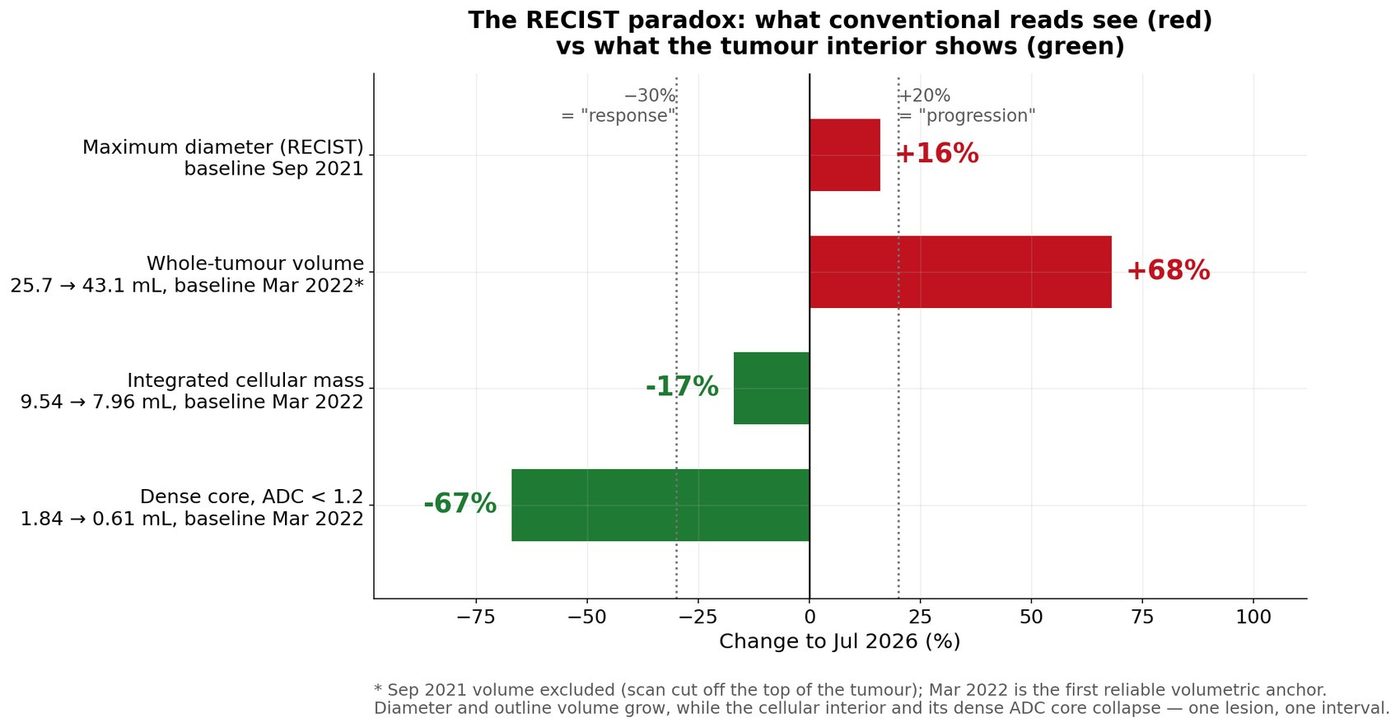
Direction 7 →Five lesions responded in ways no one disputes, and two millimeter-scale sentinels never changed. The eighth — the largest — was called “growing” on every conventional read for five years, while the tissue inside it may tell a different story. On that reading, a measurement convention rather than biology is what steers a person toward an operation.
Read the case study →
The project grew out of a large donation already in process from the Rath Family Foundation to the Iliopoulos Laboratory at Massachusetts General Hospital (Harvard Medical School), and out of twenty-five years of talking with people who have VHL. In those conversations, almost everyone fears repeated brain and spinal surgery far more than their renal disease. The deficits they carry from those tumors and operations are the largest burden we have seen in this disease, and one the field has measured poorly.
The project is structured so other funders, labs and families can join at the same rung. It is the first of the rare disease pools at rarepools.com.